ProductsFamily
Cylindrical vacuum chambers
Shell rolling, flange fit-up and sealing-face machining happen in one plant, so long seams are not split across suppliers.
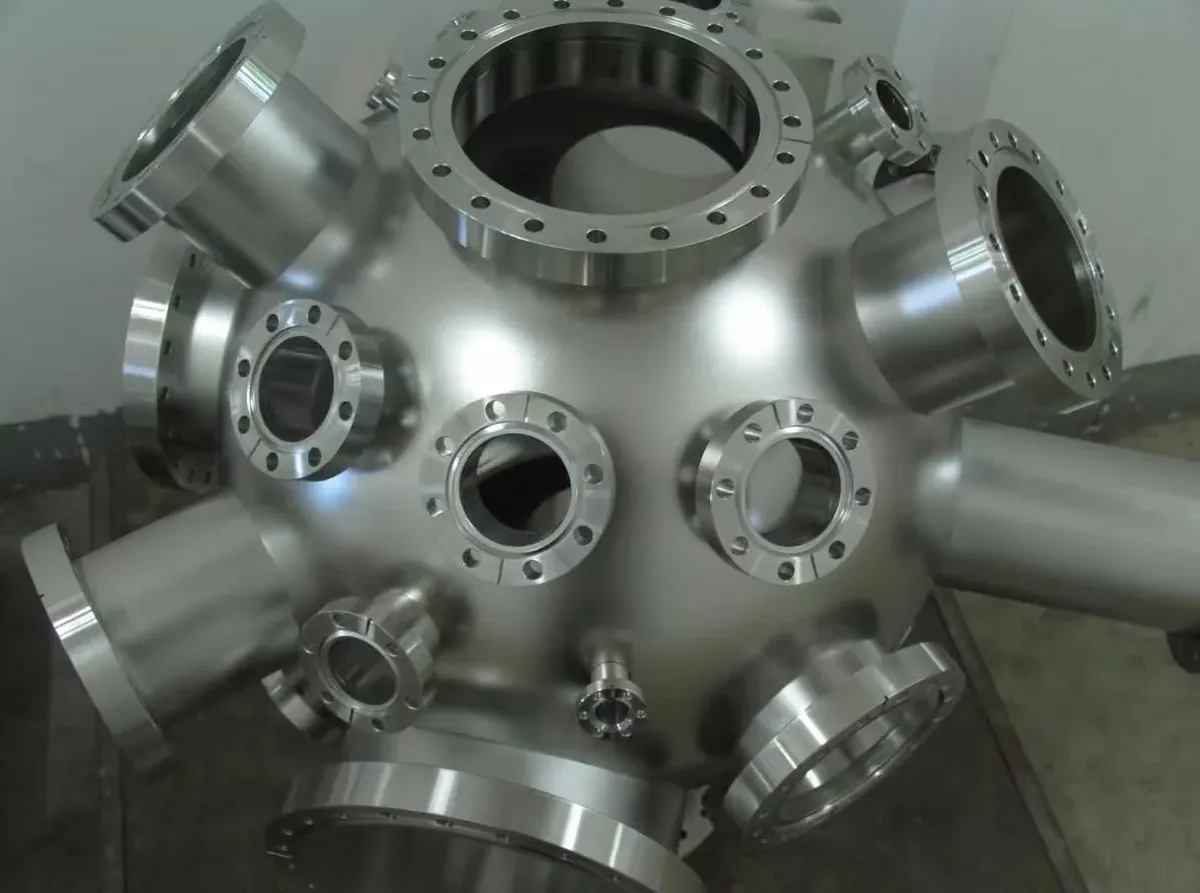
The round chamber is the most common shape in vacuum equipment: pump ports, viewports, electrodes and flanges all land on the shell and its end caps. We keep shell rolling, cap forming, flange fit-up and sealing-face machining in one plant, so tolerance does not pile up across outside subcontractors.
How it is built
The shell is rolled to drawing and its longitudinal seam welded; end caps are formed separately and then fitted to the shell. Flanges are aligned on hole pattern and sealing face before welding, with re-straightening and surface work after. Sheet grade (304 / 304L / 316L) and thickness follow the drawing, with 30 kW laser blanking and 6.2 m bending and rolling in house.
Interfaces and fits
Pump ports, viewports, electrode feedthroughs and gauge ports are placed and oriented to drawing; flange standard and seal type (O-ring groove, knife edge, CF) follow the drawing, and anything unmarked is agreed at review. Multi-tonne units are lifted and turned whole under the 50 t crane, so assembly and welding do not need to be split into pieces.
How it is verified
Every unit is helium leak tested after welding, in the 1×10⁻⁹ Pa·m³/s range; critical dimensions are recorded to the agreed scope and the records ship with the chamber. Base pressure depends on the pump set, seals and process, so we do not quote a system figure here — test conditions are agreed per project.
Technical summary
The table states the range we can confirm; dimensions, tolerances, thickness and flange standards are settled at drawing review.
| Material | 304 / 304L / 316L stainless, grade and thickness to drawing |
|---|---|
| Forming | Rolled shell plus formed caps; 30 kW laser blanking, 400 t / 6.2 m press brake |
| Welding | TIG and automated welding across 40-plus stations in a controlled clean welding bay |
| Lifting and assembly | Multi-tonne units lifted and turned whole by the 50 t crane |
| Testing | Helium leak test per unit in the 1×10⁻⁹ Pa·m³/s range; critical dimensions recorded as agreed |
| Dimensions and tolerances | Agreed at drawing review, including flange standard and seal type |
What buyers ask
Can you work to our flange standard?
Yes. Put the standard, size and seal type on the drawing. If they are missing we propose at review and wait for your confirmation rather than substituting our own.
Who decides wall thickness and material?
Your drawing does. If it is still open we can suggest values from load, lifting and opening reinforcement, but they go into the confirmed drawing.
How is lead time quoted?
From piece count, thickness, number of openings and the process route. It is quoted together with the price; we do not promise fixed days on this page.