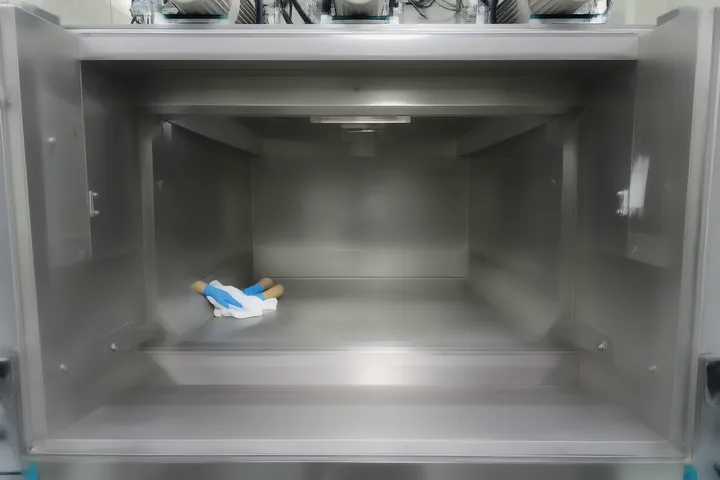
Nine times out of ten the problem is outgassing, not leakage. Two sources dominate: water, and hydrogen trapped in the damaged surface layer. Baking and pumping time address the first; only the cleaning process addresses the second.
1. Water follows a simple empirical law
For all vacuum metals — stainless, copper, aluminium, titanium — room-temperature water outgassing is about 3×10⁻⁹/t (hours) in mbar·L/(s·cm²). Ten times the pumping time gives one order lower outgassing and pressure. Two consequences: pumping longer is not folklore, and a cleaned chamber must be pumped immediately — a re-saturated water layer wastes the pumping already done.
2. Baking fixes water, not hydrogen
Measured after 10 h pumping on stainless (Torr·L/(s·cm²)): H₂O from 2×10⁻¹⁰ to 1×10⁻¹⁴, four orders; CO from 5×10⁻¹² to 1×10⁻¹⁴; H₂ from 7×10⁻¹² to 5×10⁻¹³, barely one order and then flat. Hydrogen needs vacuum annealing or long pumping — the most commonly misread point when choosing a process route.
3. Baking temperature follows the material
Copper and aluminium reach below 10⁻¹³ with 150–200 °C for 24 h; stainless needs above 200 °C, up to 300 °C, and millimetre-thick walls may need repeated bakes. In-situ baking above 120 °C for at least 12 h is effective on metal, with 150–250 °C for 24 h as common practice, mainly for water. Viton is limited to about 200 °C; overheating deforms or decomposes it into a contamination source. This is why aluminium chambers bake easily and steel ones do not.
4. Three criteria for ending a bake
Pressure stops falling at temperature; pressure returns to target after cooling; and the mass-18 (H₂O) peak drops below mass 28 (CO/N₂) on the RGA. The first two are gauge readings; the third requires an RGA. Without one, calling a bake complete is guesswork.
5. Cleaning has three layers, not one wipe
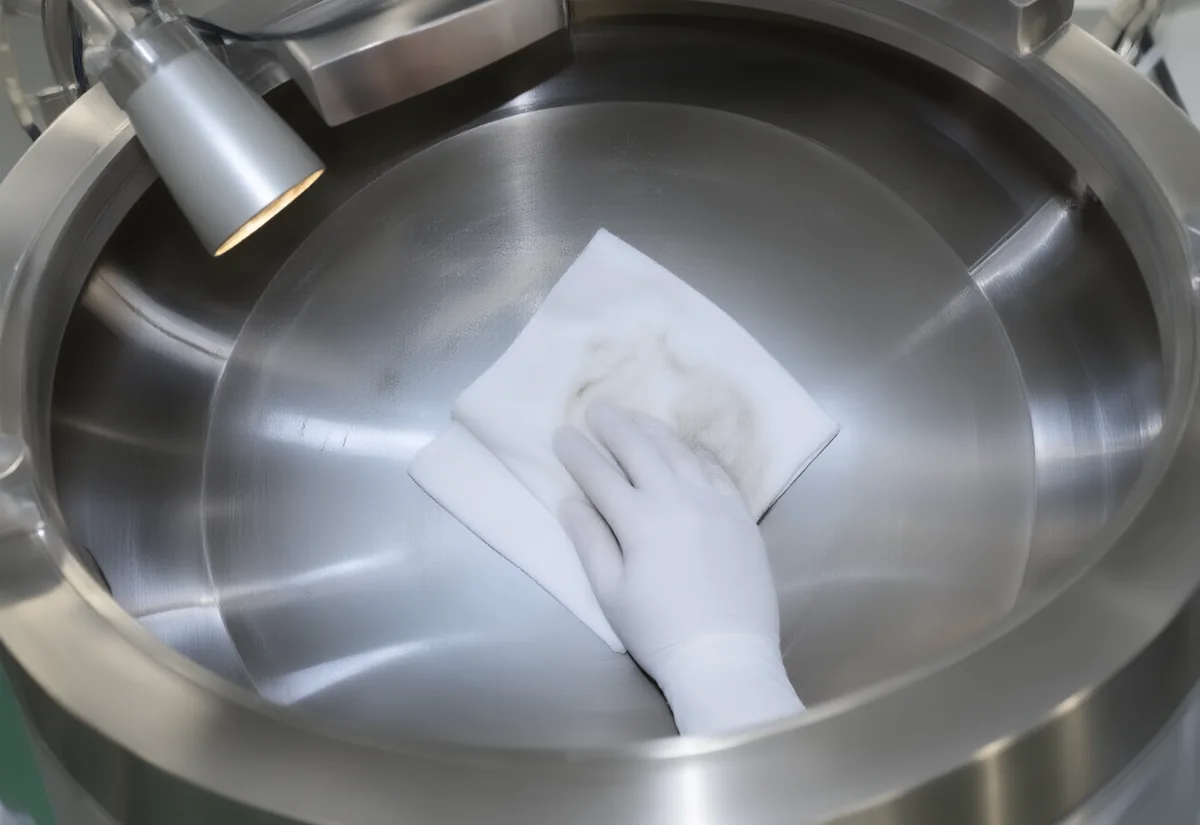
Grease, fingerprints and loose particles (solvents, alkaline detergent, ultrasound); oxide and contaminated films (acid, electropolish or chemical polish); and the damaged layer (vacuum annealing, ion bombardment). Skipping the third is the most common domestic shortfall: the surface looks clean, but hydrogen and impurities in the damaged layer bleed out, pressure stalls at 10⁻⁷ and baking cannot rescue it. A single bare-hand contact can outgas enough to cancel hours of baking.
6. One O-ring costs two orders
A baked all-metal system reaches 10⁻¹⁰–10⁻¹¹ mbar ultimate; a single elastomer seal drops the ultimate to the 10⁻⁸ range. That is the quantitative basis for all-metal, CF-knife-edge construction in UHV — not a matter of taste.
7. Check the vintage of any particle number
ITRS 2003 (FEP Table 70a): critical particle diameter 50 nm with 59 per wafer in 2003, 40 nm with 97 in 2005, 32.5 nm with 80 in 2007, 25 nm with 68 in 2009; critical GOI surface metals ≤0.5×10¹⁰ atoms/cm², other critical metals ≤1×10¹⁰, surface carbon 1.8×10¹³, mobile ions 1.8×10¹⁰. This is the 2003 roadmap and today’s limits are tighter: the value lies in units, magnitude and definition, not as a current standard.
8. Counter-intuitive: handling is dirtier than the chamber
ITRS 2003 Table 109a (defects/m², 54 nm equivalent): plasma etch 1049, CVD insulator 854, metal PVD 591, wet bench 474, CMP clean 397, while wafer handling is only 33, falling to 6 by 2009. Robots, lift pins and slit valves contribute more particles than the chamber itself — watching only the inner wall aims at the wrong target.
9. 4 Å and Ra 0.1 µm are not the same thing
ITRS specifies LVGX RMS 4 Å (about 0.4 nm) on the wafer; domestic electropolishing commonly quotes Ra 0.1–0.2 µm, an industry rule of thumb. Two orders apart, and different definitions (RMS versus Ra). Neither equate electropolish Ra with wafer-level requirements nor condemn a chamber on Ra alone: gas flow, flow field and handling sit in between.
10. Four rules that can be followed as written
Pump immediately after cleaning, never overnight in the shop; set bake temperature by material and keep Viton below 200 °C; end the bake on the three criteria, one of which must be the RGA 18/28 comparison; finish with glow discharge cleaning where residual surface contamination matters. Cleaning is a process with criteria, not an action; an action without a criterion has not been performed.
Outgassing and particles are separate problems: one is surface chemistry, the other is flow field and moving parts. Both need criteria, and criteria need to be reproducible.
Frequently asked questions
The chamber was cleaned but still will not pump down — what first?
Separate outgassing from leakage first. Water-vapour outgassing decays as roughly 3×10⁻⁹/t per hour; if the surface water layer has re-saturated after cleaning, the pump-down time already spent is wasted.
How much does baking solve?
Baking at 250 °C for 24 h pulls water vapour down about four orders of magnitude (2×10⁻¹⁰ → 1×10⁻¹⁴), but hydrogen by only one order; hydrogen needs vacuum annealing or a long pump-down.
How is a particle requirement converted to a per-wafer figure?
Through critical particle diameter against allowed defect count: the order of magnitude given by ITRS 2003 is 25–50 nm corresponding to 59–97 particles per wafer. Current thresholds are stricter — the customer specification governs.