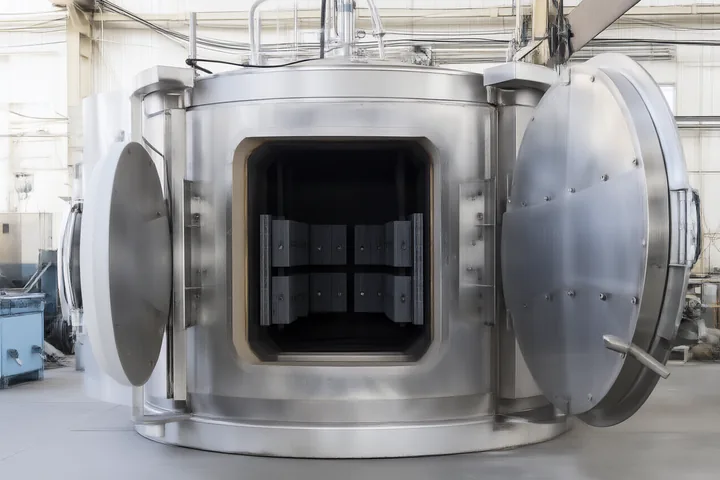
The order matters: how the load enters, where the heat goes, how thick the shell must be, how large the pumps are, how the interlocks are wired. Get the order wrong and the door, the hot zone and the wall thickness all get redone.
1. Duty: 10⁻⁴ to 10⁻⁶ Torr, and the hardest moment is start-up
Metallurgical vacuum furnaces run in the 10⁻⁴–10⁻⁶ Torr high-vacuum range, but the design is governed by initial evacuation: the run from atmosphere to process pressure carries the largest gas load and takes the longest, and the pumps and piping are sized for it rather than for steady state.
2. Cold wall or hot wall
A hot-wall furnace heats the whole chamber, which doubles as the heating element: good outgassing, but seals must survive temperature and the shop gets hot. A cold-wall furnace uses a double wall with water in the annulus, keeping the seals cool at the cost of poorer chamber outgassing and longer purge. Cold wall is the engineering default because seal temperature is a hard constraint while outgassing can be recovered by purge and pumping time.
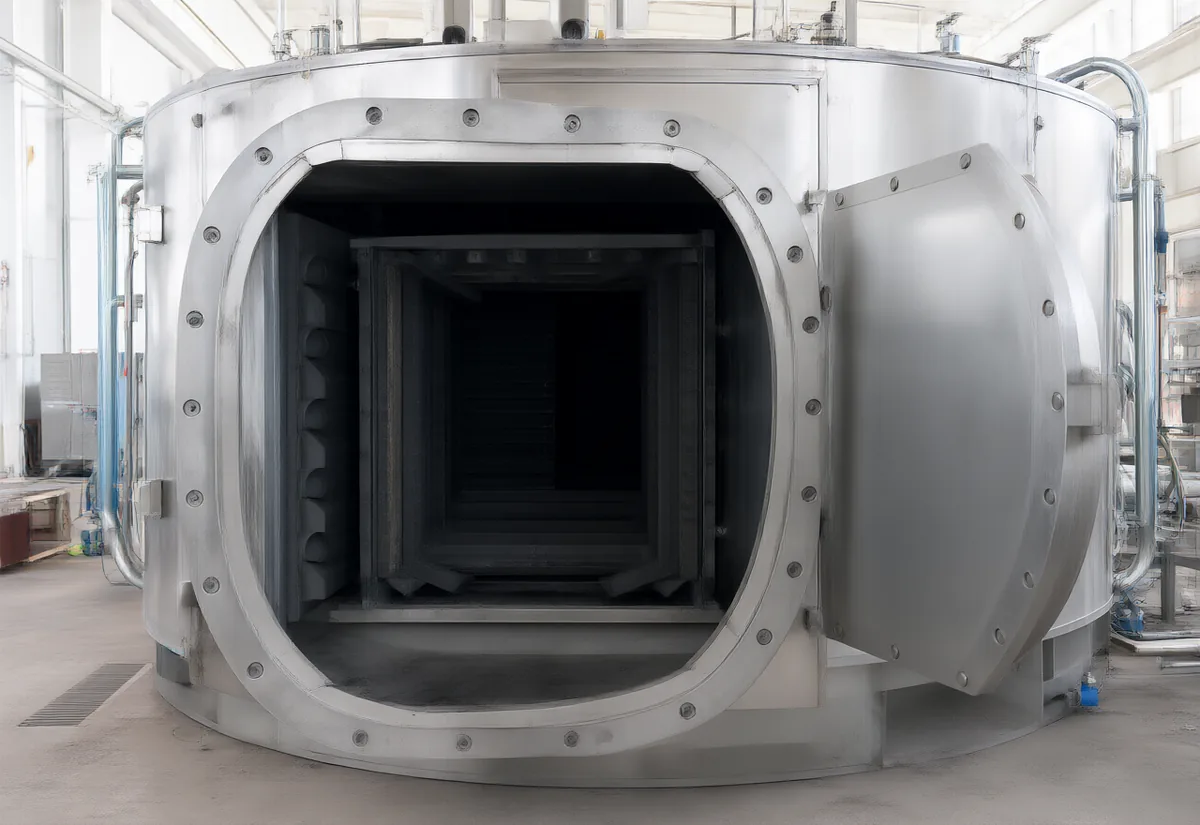
3. Hot zone and heat transfer
Heating elements, multilayer radiation shields, supports and a water-cooled jacket. At 10⁻⁶ Torr convection disappears, leaving radiation and solid conduction: Stefan-Boltzmann with emissivity and view factors, iterated layer by layer to fix shield count and equilibrium temperature, with I²R as the source. Insulation is therefore stacked metal shields, not a blanket, and the count comes from calculation.
4. Choose elements by temperature, not price
Kanthal ≈900 °C, molybdenum ≈1400 °C, tungsten and tantalum higher, graphite highest but limited by carbon contamination. One grade wrong can cut element life from thousands of hours to hundreds. Strip elements also arc at sharp edges under high voltage and should be replaced by thick round sections.
5. How thick the shell must be: 4 mm fails, 5 mm passes
The shell carries a full atmosphere: design differential 1.3 atm ≈ 0.13 MPa, plus static head in the cooling jacket. External-pressure stability follows the ASME allowable Pa = 4B/[3(D₀/t)] with the criterion Pa > Pd. For 1000 mm bore at 5 mm wall, D₀/t = 202 and L/D = 1.98; at 4 mm the allowable is 0.074 MPa, below 0.13 and rejected; at 5 mm it is 0.15 MPa and passes. One millimetre is the difference, which is why the thickness is calculated rather than padded.
6. Sizing pumps: conductance first
Effective pumping speed is a series impedance: 1/S_eff = 1/S_pump + 1/C. Choke the conductance and pump size stops mattering. A typical train is diffusion pump, rotary vane and Roots blower, with the vane pump roughing and backing through valves and a hogging pump taking atmosphere down to 10⁻³ Torr; during the run to 10⁻⁶ Torr the blower can be bypassed to save power and water, and gate valves are preferred for their conductance.
7. Sealing: twin gaskets with intermediate pumping
Higher-duty furnaces use two gaskets with a small pump evacuating the space between them, taking the single-seal leak rate down by an order of magnitude for the cost of one more seal.
8. Four interlocks, and opening is riskier than closing
No other pump without the backing pump; no heating below vacuum; no process until the H₂O partial pressure falls; no power with the door unsealed. Before opening, cool fully, vent slowly and confirm zero differential on a sensitive ΔP gauge — slight positive pressure alone can throw the door open. Two routine failure sources: water, which destroys vacuum the moment the shell leaks and is watched on the RGA H₂O peak, and leak testing done hot rather than cold and unloaded.
9. Two structural rules of thumb
Loading defines the structure: bottom loading for heavy parts, top loading with a crane, front opening for long light parts; rectangular chambers offer volume but concentrate stress at the corners, cylindrical ones are more robust. Heat-up must be ramped: too fast creates steep gradients and intense radiation that kills the hot zone first.
Structural design is a chain of trade-offs — heat against sealing, wall thickness against cost, flexibility against seal reliability. Each can be calculated, and calculating before committing is cheaper than reworking. Specific projects still require their own check against drawing, material and duty.
Frequently asked questions
What design pressure is a vacuum chamber sized for?
A design differential of 1.3 atm (about 0.13 MPa) is used for the external-pressure check; a water-cooled jacket adds the static head of the water.
How is wall thickness determined?
By the ASME external-pressure expression Pa = 4B/[3(D₀/t)], with the criterion Pa > Pd. Worked example: at 1000 mm inside diameter, a 4 mm wall gives 0.074 MPa and fails; a 5 mm wall gives 0.15 MPa and passes.
Cold-wall or hot-wall furnace?
Seal temperature is the hard constraint, while outgassing can be bought back with purge and pump-down time, so cold-wall is the engineering default. For a small furnace with strict cleanliness, hot-wall trades seal temperature capability for lower chamber outgassing and can be the better deal.